
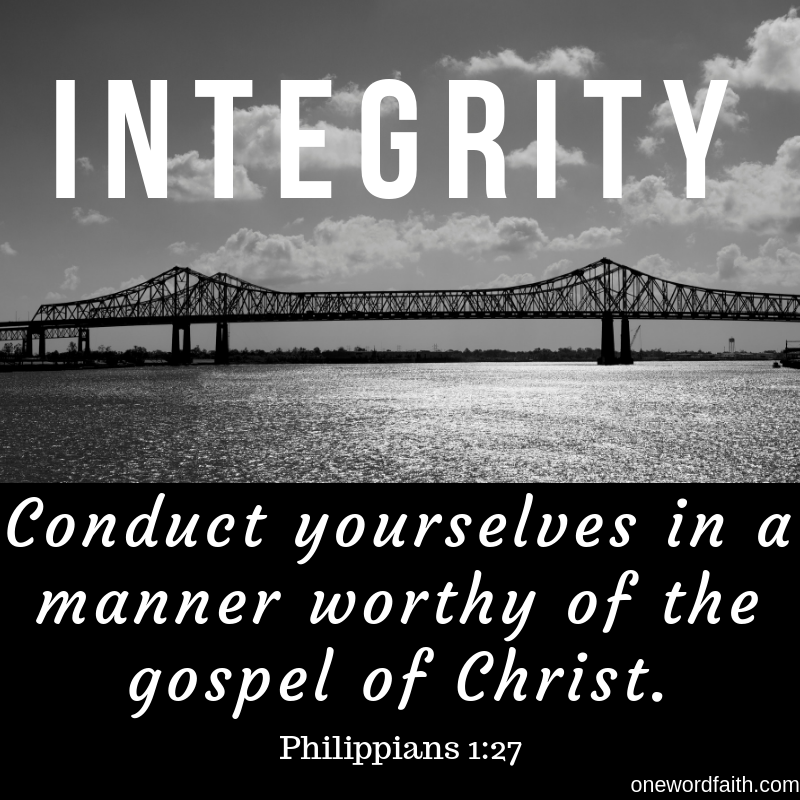
Integrity (noun): the quality of being honest and having strong moral principles; a sound or unimpaired condition; having a moral compass that doesn’t waver; the state of being whole and undivided
As I was studying the book of Philippians, a verse caught my attention in one of those ways that tells me God wants me to pay attention.
Whatever happens, conduct yourselves in a manner worthy of the gospel of Christ. Philippians 1:27
I wrote the verse in my journal and reflected on the words. As I did so, the word “Integrity” came to the forefront of my brain. Even though the word itself is not used in this verse, it seemed to me that this verse is the definition of Integrity – perhaps not the world’s definition, but certainly God’s definition.
I searched the online dictionaries for Integrity, and generally found that it’s rooted in having qualities of honesty and moral principles. When I think of Integrity, I immediately go the questions:
- Do my actions match my words?
- Do I do what I say?
- Do my deeds match my beliefs?
Brene Brown puts it this way: “Integrity is choosing courage over comfort; choosing what is right over what is fun, fast, or easy; and choosing to practice our values rather than simply professing them.”
As I reflect on my own level of integrity, in particular as I face important decisions, I have found it helpful to ask myself these questions during my decision-making process:
- How would I feel if my decision/action was in the headlines of the morning newspaper tomorrow?
- Would I want my Grandma (in other words, a highly respected person in my life) to know what I said/did?
- What if my FaceBook live feed came on accidently at the moment I lived out my decision?
Having integrity means I am true to myself and would do nothing that demeans or disgraces my character. I am a Child of the King! My thoughts, words, and actions represent Him. If I dishonor myself, I dishonor Him!
God is pleased when I live out integrity.
I know, my God, that you test the heart and are pleased with integrity. 1 Chronicles 29:17
God reveals people of integrity throughout the Bible: Job, Levi, Noah, Paul, the midwives who save Moses, Ruth.
His wife said to him, “Are you still maintaining your integrity? Curse God and die!” Job 2:9
In everything set them an example by doing what is good. In your teaching show integrity. Titus 2:7
True instruction was in his mouth, and no wrong was found on his lips. He walked with me in integrity and uprightness, and he turned many from iniquity. Malachi 2:6
Jesus is our ultimate model of integrity! Jesus’ actions aligned with his words and stories. Consistently. Reliably. Dependably. In Mark 12:14, his disciples recognize this, as they say: “Teacher, we know that you are a man of integrity.”
Many examples of integrity come to mind as I consider the life and ministry of Christ:
- Jesus tells us in Matthew 20:28 that “the Son of Man came to serve”, and then demonstrates this when he washes the feet of his disciples (John 13).
- In John 3:17, we find the words that Jesus was sent to “save the world”, which he accomplishes through his death on the cross.
- Jesus tells Zacchaeus in Luke 19:10 that “the Son of Man came to seek and to save the lost”, and then validates this in many personal encounters documented in the Gospels (such as the Woman at the Well, Saul’s conversion to Paul, etc.)
- In John 5:30, we hear Jesus say “I seek not to please myself but him who sent me”, and he lives out this trait as he faces the temptations of Satan in Matthew 4.
As I reflected on these examples, my mind considered this question:
- Can I have integrity as a Christian, but not in my job?
- Or integrity in my family but not as a Christian?
- Can integrity exist in one “area” of life, but not in others?
I think not.
One of the definitions of integrity is “the state of being whole and undivided”. If I live out integrity in only a part of my life, I am not “whole” or “undivided”! For example…
- If I’ve said that my family is more important than my job…do my actions and decisions reflect that?
- If I’ve signed an Employee Agreement with my Company/Clients to follow their Code of Conduct… do my actions reflect that?
- If I’ve made a membership commitment to a church to give generously of my time, resources, prayer, and witness…do my actions reflect that?
- If I’ve made vows to be faithful and respectful to my spouse…do my thoughts and actions reflect that?
Integrity implies trustworthiness and incorruptibility to a degree that one is incapable of being false to a promise, responsibility or pledge. In the Christian perspective, it’s not just about our words matching our actions, but also that our words, beliefs, thoughts, behaviors, deeds are in harmony with the Gospel.
Integrity is a character trait that either exists or does not. There is no such thing as “partial” integrity.
Think about “Structural Integrity” – which is the ability of a structure to withstand its intended load without failing due to fracture, deformation, or fatigue. This is a concept used in engineering to produce items (e.g., bridges, buildings) that will serve their designed purposes and remain functional for its intended life span.
Structural integrity exists, or it doesn’t. Once it exists, maintenance is needed in order to keep it. Regular inspections, corrective actions, reinforcements, are needed in order to prevent fracture, fatigue and failure. To preserve the integrity.
People are the same way. I don’t just “achieve” integrity at a point in time and then sit back and relax. I need to be diligent toward the maintenance of my integrity!
- Am I feeding my soul with His Word daily?
- Do I intentionally reflect and observe my behaviors…are they aligned with my words and values? Has there been a “slow fade” that needs to be corrected?
- Do I have any unrepented sin? An antonym of Integrity is sin. When I have unrepented sin in my life, my structural integrity is compromised.
- Am I conducting myself in a manner worthy of the gospel of Christ?
Gracious Father,
Help me to be a person of integrity.
This day and every day.
Amen