
Perspective (noun): a particular attitude towards or way of regarding something; a point of view. Synonyms: outlook, position, stand, interpretation, approach
If I wanted to understand your “perspective” of life, I might ask you a series of questions like this:
- When you see a dandelion… do you see a weed or a wish?
- When you see a scar…do you see the wound or the healing?
- When you see a closed door…do you see a rejection or protection?
- When you see the weather forecast icon with the sun peeking behind a cloud… do you see partly cloudy or partly sunny?
- When you see a cross…do you see the crucifixion or the resurrection?
The perspective of these things is influenced by which “eyes” are used to see them. Eyes of despair or hope. Eyes of resentment or forgiveness. Eyes of selfishness or service. Eyes of shame or honesty. Eyes of worry or faith. Eyes of judgment or compassion.
I tend to see the extremes of the answers to these questions. But there’s a great spectrum between. Extremes lead me to judging. I could get into a debate over which perspective is best, but where would that get me?
It’s not “wrong” or “bad” to have one perspective or the other. Maybe if I tend to see the wound, it’s time to focus on the healing. Or if I tend to see the healing, maybe it’s time to recognize others haven’t healed yet.
Maybe polarized perspectives aren’t the answers at all.
What about life through a dog’s eyes? A child’s eyes? If someone “has perspective”, it means she has a “sensible” outlook on life. What it probably really means is that she has a similar perspective to my own.
Do we become “known” for our perspectives? Do we attract or repel others by our perspectives?
Our perspectives do not define us. They represent our education, our experiences, our values, and our personalities. But they also represent our struggles, yearnings, and attempts to grow, learn, and change. By expressing a perspective, I get to “feel” a response to it by my inner being and observe responses from others. After sharing it, perhaps a “bad taste” lingers in my mouth. It was only by saying the words did I realize how salty they were!
I have the right to change perspective. So do you. I have the right to express my perspective. So do you. Each of us has the responsibility to respect one another’s perspectives.
A better set of questions to ask ourselves:
- Do I spend more time trying to persuade others to see my perspective than I spend trying to see others’ perspectives?
- Do I try to convince others of the sensibility, goodness, or rightness of my perspective?
- Am I idolizing someone else’s (such as a celebrity or government leader) perspective?
- Am I looking through eyes of the flesh or eyes of the heart?
- Am I using sight or vision?
For we live by faith, not by sight. 2 Corinthians 5:7
You were taught, with regard to your former way of life, to put off your old self, which is being corrupted by its deceitful desires; to be made new in the attitude of your minds. Ephesians 4:22-23
Biblical teaching defines perspective as “the attitude of your mind”. Perhaps the attitude of my mind would be better off thinking and saying statements like this:
- I appreciate your perspective.
- I could be wrong.
- I’m open to seeing this from a different perspective.
- I’m willing to hear your perspective.
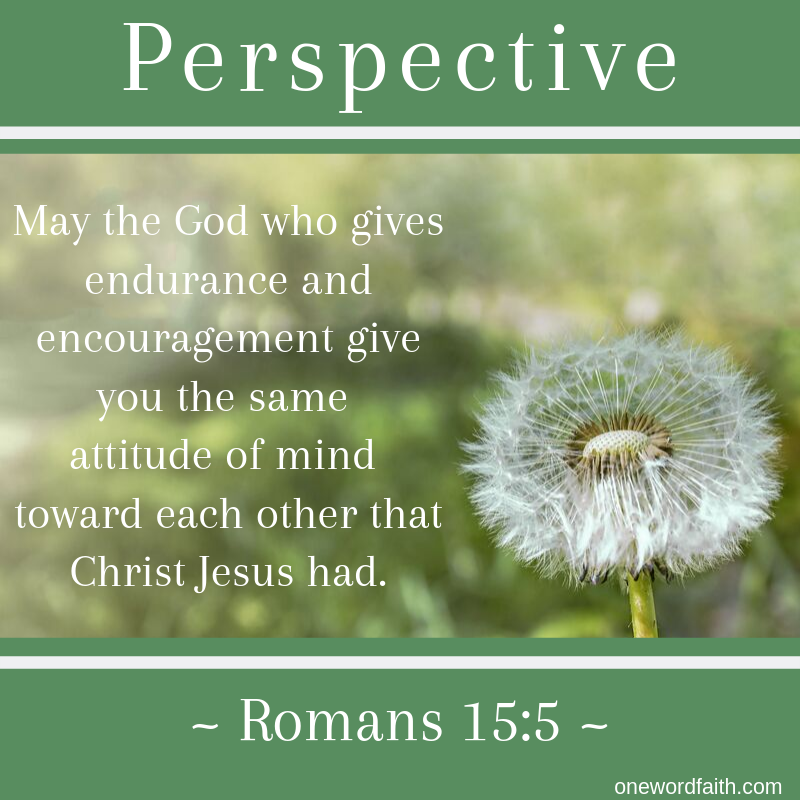
May the God who gives endurance and encouragement give you the same attitude of mind toward each other that Christ Jesus had, so that with one mind and one voice you may glorify the God and Father of our Lord Jesus Christ. Romans 15:5-6
My aim is to develop “the same attitude of mind towards other that Christ Jesus had”.
What difference an outlook has when viewing through a binoculars the designed way versus the opposite way. I can enlarge problems or minimize them, based on the viewpoint. What about looking through Christ’s eyes?
He might say: “Why are you looking at the problem at all? Look at me instead!”
I love to Bible study with other people, because even though we each read the same words of a scripture verse, we each have a different perspective. Hearing other people’s perspectives on the verses give me an even deeper understanding and appreciation for His Word, and for the person sharing their perspective.
For example, read the story of the disabled man by the pool in John 5.
Each of us will have a different perspective on this story based on our experience, knowledge, and personality. One might find hope in the story – if we are patient, healing will come. Another might find discouragement in the story – you mean I have to wait 38 years for healing?! One sees the story as testimony to Christ’s love and mercy. Another might question why all are not “worthy” of His healing.
Our different perspectives about this story will be influenced by our optimistic or pessimistic natures, our personal experiences with long-term suffering, and our level of knowledge of Christ’s miracles recorded elsewhere in the Bible.
Another example of how perspectives can vary so greatly: What if we asked different people to “Describe the world”?
- A child not ever exposed to the world beyond their home, who is not yet educated, might describe his family and his house. This is his world, the only world he knows.
- A person who has been educated about the natural earth, but not yet directly experienced the world might describe the physical nature of the world – a large mass of rock and water, mountains, canyons, oceans and deserts.
- One who has travelled the world significantly, lived among people of various nations and climates, might describe the world as “a diverse set of people”.
Is any perspective “wrong”? No.
What do they have in common? They are each INCOMPLETE.
This is why I need to stay open and willing to learn and see other people’s perspectives. I hold only one piece of the puzzle and if I believe it to be the whole picture, I miss out on the opportunity to see the true Masterpiece.
My desire is to hang on loosely to my perspective so I’m willing to let it go as I gain experiences and knowledge.
I welcome changes in my perspectives as I learn to see from a different point of view: His.